





Large Stock Available
Domestic & Commercial
Installation Within 10 Days
Quality<br>Of Work
Parking Security
Price Match Guarantee
Do Steering Wheel Locks Work?

Of the many products you can buy today to help protect and secure your car from thieves, steering wheel locks are among the more popular options. The principle is simple… It locks onto your car’s steering wheel, and with a long, (usually) steel, protruding rod, this makes it nigh impossible to turn the wheel without first removing the steering wheel lock. Without being able to steer, the steering wheel lock makes it harder for your car to simply be driven off. Some steering wheel locks even come with an additional bar to fully press down onto the brake pedal. But, its effectiveness in preventing theft remains questionable, so do steering wheel locks actually work? Well, here’s a TL;DR on what I think:
Yet, I can’t help but shake off the feeling that steering wheel locks have way more flaws and downsides that might not be immediately apparent when you’re shopping for one. Yes, steering wheel locks do work, but they’re not as effective at preventing theft as some might assume. In fact, if you’re looking for top-notch security for your beloved car, there are so many other, better alternatives out there (at the end, we’ll discuss what is no doubt the best and most secure one for you).
With that in mind, here are some of the noteworthy cons with steering wheel locks that you need to consider before buying one:
1. It’s Not A Foolproof Solution
The most damning argument against fitting steering wheel locks in your car is how surprisingly easy it is to bypass it. A well-equipped car thief might have all the tools they need to pick the lock that secures the steering wheel lock in place. Or, they could even just brute force it and crack the steering wheel lock open. One of the most popular techniques I’ve seen deployed is using Freon or refrigerant spray to free the lock itself, thus making it brittle, and breaking it.
It’s worth bearing in mind that not all steering wheel locks are made the same. Most cheaper steering wheel locks, for example, are far more susceptible to being bypassed and brute forced into, than the pricier options. For example, I saw how the guys at Donut Media, when testing various car security products, found a critical flaw in one of the steering wheel locks they tested. There, they found that one vital part of the steering wheel lock was a thin piece of metal, which could be handily (and silently) beaten by a pair of bolt cutters.
In short, buying a steering wheel lock can be a bit of a gamble… You might end up with a good one that’ll hold up to whatever speciality tools or clever hacks a car thief employs to remove it. Or, you could end up with the same steering wheel lock that took mere seconds for the guys at Donut Media to break through and then have unimpeded access to the steering wheel. Remember, standard lock-picking tools are really easy to find, and there is an abundance of guides and videos online that’ll unintentionally teach you how easy it is to use them.
2. The Inconvenience With Using Them
While a steering wheel lock is comparatively easy to use and intuitive at first, needing to remove and install it onto your steering wheel every single time gets really tiresome pretty quickly. It’s very cumbersome, especially when you need to get somewhere in a hurry, or if you have physical ailments that can make it more challenging to exert the force needed to remove a steering wheel lock. Those few minutes you exhaust trying to undo that lock add up, and I’ve lost count of the number of times where I just couldn’t be bothered trying to install it.
This matters, because the cumbersome nature of the steering wheel lock might lead to situations where some folks might opt to say ‘forget this, I’m not dealing with this right now’, and neglect to use their steering wheel locks. Obviously, this will leave your vehicle exposed and vulnerable to theft, when all you’re relying on is that steering wheel lock. For someone who commutes daily and spends a lot of time getting in and out of my car, it just isn’t as practical or as effortless as some of the marketing might lead you to believe.
3. Taking Up Excess Storage Space
Speaking of inconvenience, where does one stow the steering wheel lock after you’ve removed it? Most of the people I know simply chuck it into the passenger floor well, or throw it onto the rear seats. Given how large a steering wheel lock is, no matter where you toss it when it’s not in use, it only ends up taking up valuable space in your car. That’s particularly so in smaller vehicles, like sports cars or superminis, where in-car storage space can be really hard to come by, and is already rather limiting to begin with.
All that space could’ve been used for something else, instead. And even if you’re able to find somewhere where you could stow that steering wheel lock, it adds to unnecessary clutter. There are many other, smaller security solutions you could get for the money, and as we’ll discuss later down below, we have an alternative that won’t take up any precious in-car storage space, at all!
4. Potential For Causing Damage
Even if it does prevent theft, is a steering wheel lock worth the potential damage it causes to your interior? I’ve found that frequently fitting and removing the steering wheel lock has the chance of scratching up or scuffing the steering wheel. It does depend on the steering wheel lock itself and how it’s been designed, but some of these can be pretty hard on your upholstery. The hard metal surfaces that lock onto your steering wheel wear it down seriously, particularly if your wheel is made from softer surfaces, such as leather.
On that note, the size and design of your steering wheel should be taken into consideration when you’re trying to find a suitable steering wheel lock, too. Your car’s steering wheel might be a tad thick. Or, the placement of the spokes may interfere with how the lock secures in place. Aside from incompatibility concerns, it might make it way harder to install and remove your steering wheel lock, or to have it secured enough to make sure the lock works as intended. So, make sure you take notes before checking out your Amazon cart.
5. It Provides Limited Protection
Another vital downside of steering wheel locks and why they do not always work is that they provide single-point security. They only address one aspect of your car’s security – making sure your steering wheel can’t be moved – thus leaving other vulnerabilities around your car unprotected. It doesn’t prevent thieves from starting your car, by bypassing the ignition system, nor does it prevent a thief from moving your car in just a straight line. In fact, a steering wheel lock won’t even stop thieves from merely towing your car away from you.
Thieves might otherwise adopt more advanced methods like signal jamming, relay attacks, or for older cars, it’s sometimes enough to hotwire the car. None of these could be prevented by a steering wheel lock. A multi-layer approach to car security is vital, which is why car owners often use steering wheel locks in concert with other measures, such as immobilisers, alarms, or GPS trackers. So, make sure you don’t just rely on steering wheel locks and build a false sense of confidence or complacency, expecting a steel rod to keep your car safe.
What Are the Different Types of Steering Wheel Locks?
Although the basic principle is straightforward, there are several steering wheel lock designs, each restricting vehicle control in a slightly different way.
Bar-style steering wheel locks
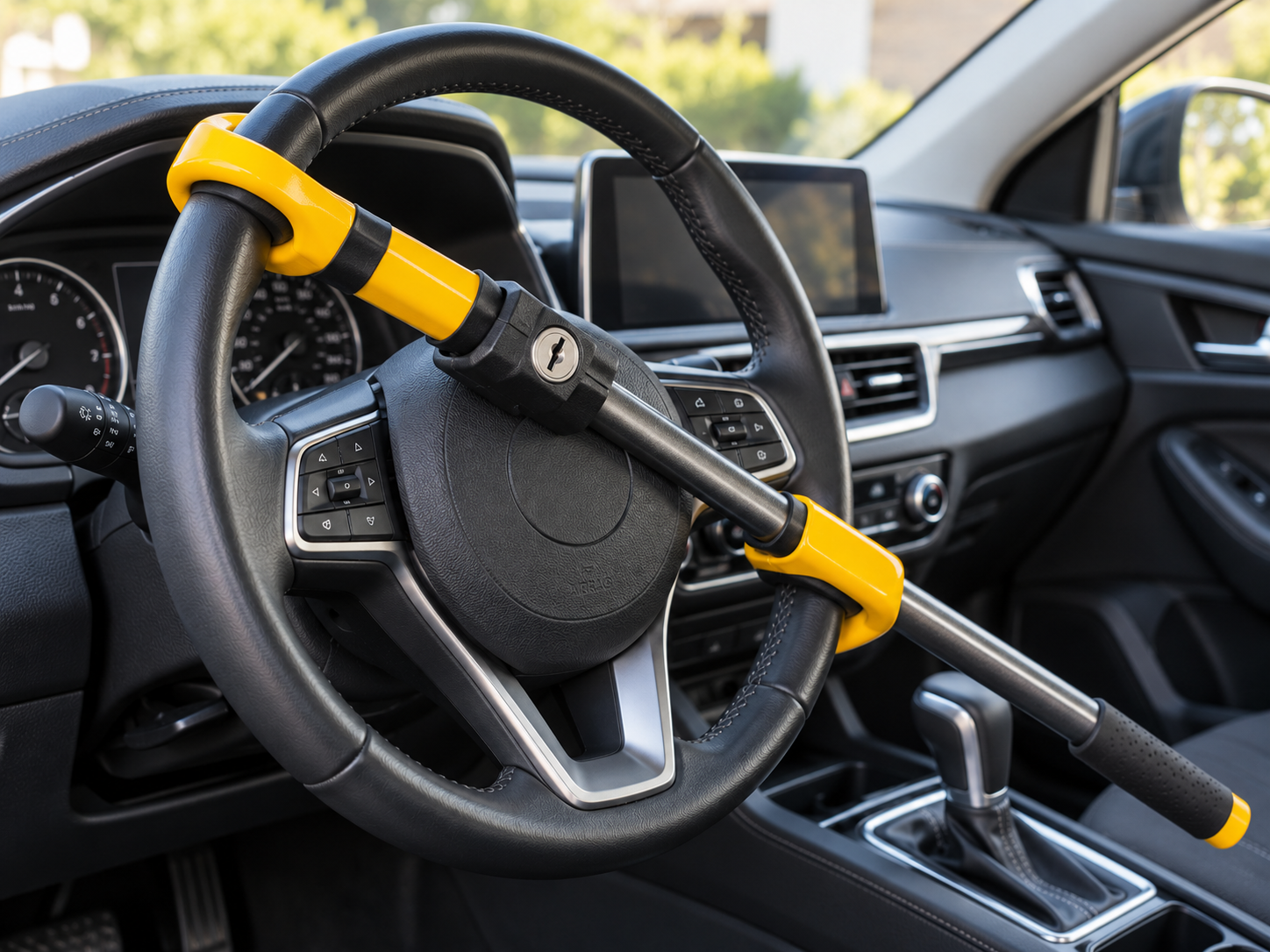
Bar-style steering wheel locks attach to the steering wheel and use a protruding bar to restrict how far it can turn. Their effectiveness depends on the construction of the bar, the locking mechanism and how securely they attach.
Full-cover steering wheel locks

Full-cover steering wheel locks enclose a larger portion of the steering wheel, making parts of it harder to access. They can provide a more substantial physical obstacle, though the design alone doesn’t guarantee better security.
Steering wheel-to-pedal locks
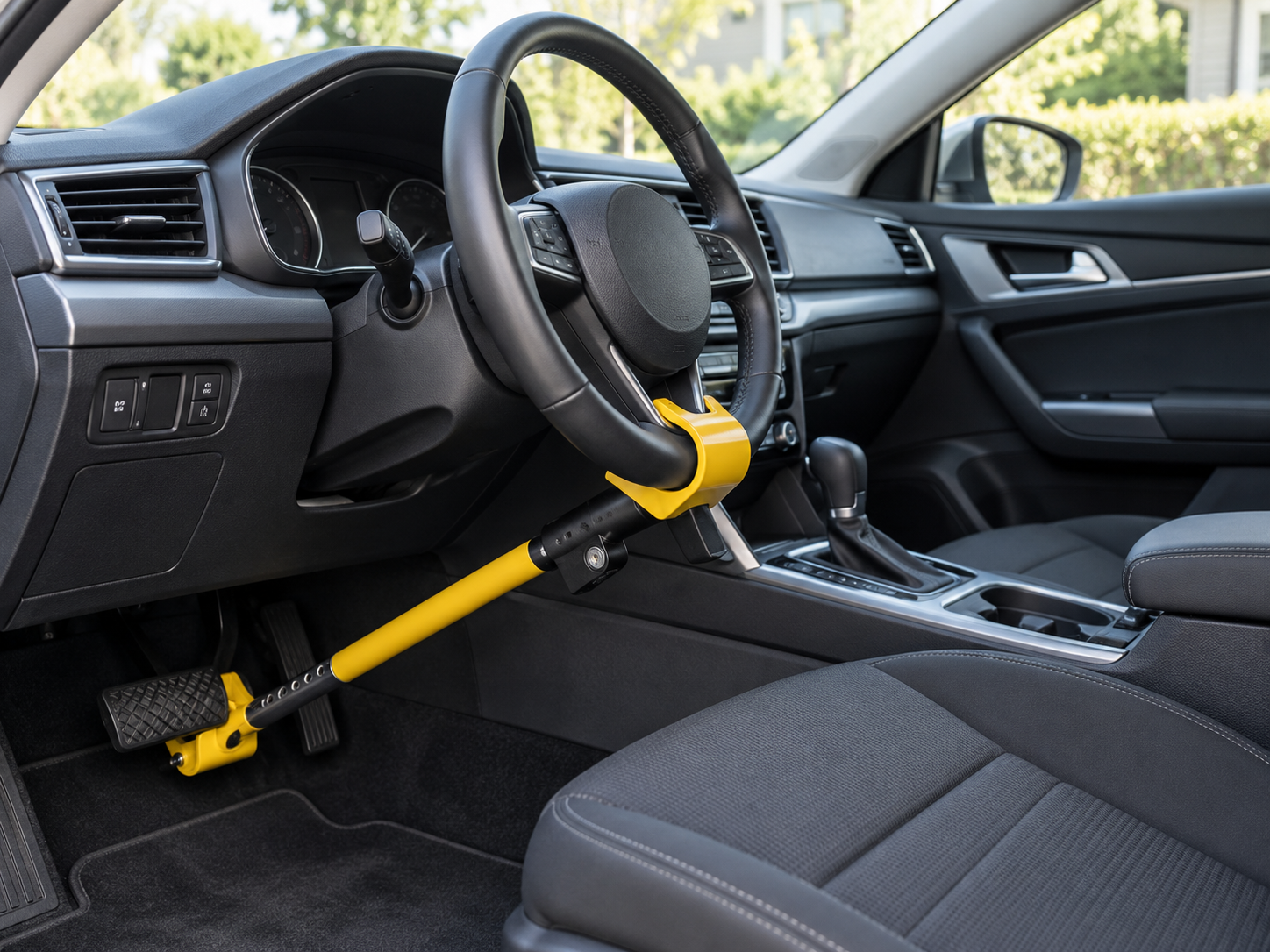
Steering wheel-to-pedal locks connect the steering wheel to a brake or clutch pedal, restricting the movement of both. Whichever type you choose, the aim is to make driving the vehicle away more difficult and time-consuming.
How Can You Tell if a Steering Wheel Lock Is Effective?
Rather than judging a steering wheel lock only by its price or weight, look for evidence of independent security testing. For example, Sold Secure assesses security products against defined testing requirements. If a manufacturer advertises a rating, check that the particular model has a current, verifiable certification.
Construction matters too. Examine the quality of the locking mechanism, the materials used and whether the design leaves components unnecessarily exposed. It’s also important to check the manufacturer’s fitting guidance: a lock that doesn’t fit your vehicle securely may offer less protection than intended.
Finally, consider whether you’ll use it consistently. A lock that’s awkward to fit may be left unused, even if it’s relatively robust. No steering wheel lock is theft-proof, but an independently tested model that’s compatible with your car can be a useful addition to a wider vehicle security strategy.
Is There A Better Alternative To Steering Wheel Locks?
So, do steering wheel locks work? Well, somewhat, and it can be sufficient in the right circumstances. But, what if I told you there’s a way better alternative to car security and theft deterrence at home? Instead of a steering wheel lock, which can be cumbersome, not as secure as some might think, and offer many inconveniences that come with it, you’d be better off installing a driveway bollard at your home. Driveway bollards are easier and more convenient to use, which are really easy to retract and stow away when you need to use them.
Plus, some of them are even automated, allowing you to raise and lower your driveway bollards with just a key fob remote. Aside from that, a properly specified and installed driveway bollard can help protect vehicles parked behind it, rather than you need to install a steering wheel lock for each one. If that’s not reason enough to sell you on the supremacy of driveway bollards for car security compared to steering wheel locks, here are some of the many benefits it offers:
- Driveway bollards provide a robust, physical barrier that prevents a car from being moved out of your driveway, which is better than a steering wheel lock, which only restricts steering.
- Unlike steering wheel locks, which need to be installed and removed every single time you need to go out for a drive, a driveway bollard is permanently fitted in place. That alone ought to save you a lot of time.
- Moreover, whereas some steering wheel locks could be readily bypassed by the right tools and a bit of elbow grease, a correctly specified, securely installed driveway bollard can provide a more substantial physical barrier, although resistance to impact depends on its design and rating.
- Speaking of tampering, and this extends beyond steering wheel locks, driveway bollards provide a more secure defence against sophisticated theft methods. This includes signal jamming or relay attacks, given that driveway bollards lack the electronic security systems that are vulnerable to such attack vectors.
- Crucially, driveway bollards don’t directly interact with your car. While a steering wheel lock needs to be fitted and removed constantly, which might risk damaging the interior, you’re not going to scratch and scuff up your car with a set of driveway bollards.
Frequently Asked Questions About Steering Wheel Locks
Are Steering Wheel Locks Worth It?
A steering wheel lock can be worth buying as an affordable additional layer of vehicle security. Its visible presence may deter opportunistic theft, while the physical restriction can make driving the vehicle away harder. Choose an independently tested model and use it alongside other security measures rather than relying on it alone.
Do Steering Wheel Locks Fit Every Car?
No. Steering wheel thickness, spoke placement and built-in controls can affect whether a lock fits securely. Check the manufacturer’s vehicle compatibility and fitting guidance before purchasing, especially if your steering wheel has an unusual shape or covering.
Is a Full-Cover Steering Wheel Lock Better Than a Bar-Style Lock?
Not necessarily. A full-cover design may shield more of the steering wheel, while a bar-style lock can be quicker to fit and remove. Independent security testing, build quality and correct fit are more reliable indicators than the style alone.